
Ad Manager
Builds grounded ad campaigns — search, display, social and video
For exampleA search campaign built from your offer — ad groups and copy — held in approvals before any spend.
ads_agent
Ask about receivables, and Invoicing answers. Not one chatbot pretending to do everything — each question goes to the specialist that actually holds the data, all reading the same customer record and coordinated by Ask Darwin.
An agent is only as good as the tools it can reach. Ours reach 174.
Below is the real roster. Where a card carries an identifier, that is the name you will see in your own audit log.
The Agent Registry is where you see each agent's type, whether it is live, what it can do and how much it has run. Filter by status, open one to change its guardrails, or switch it off.
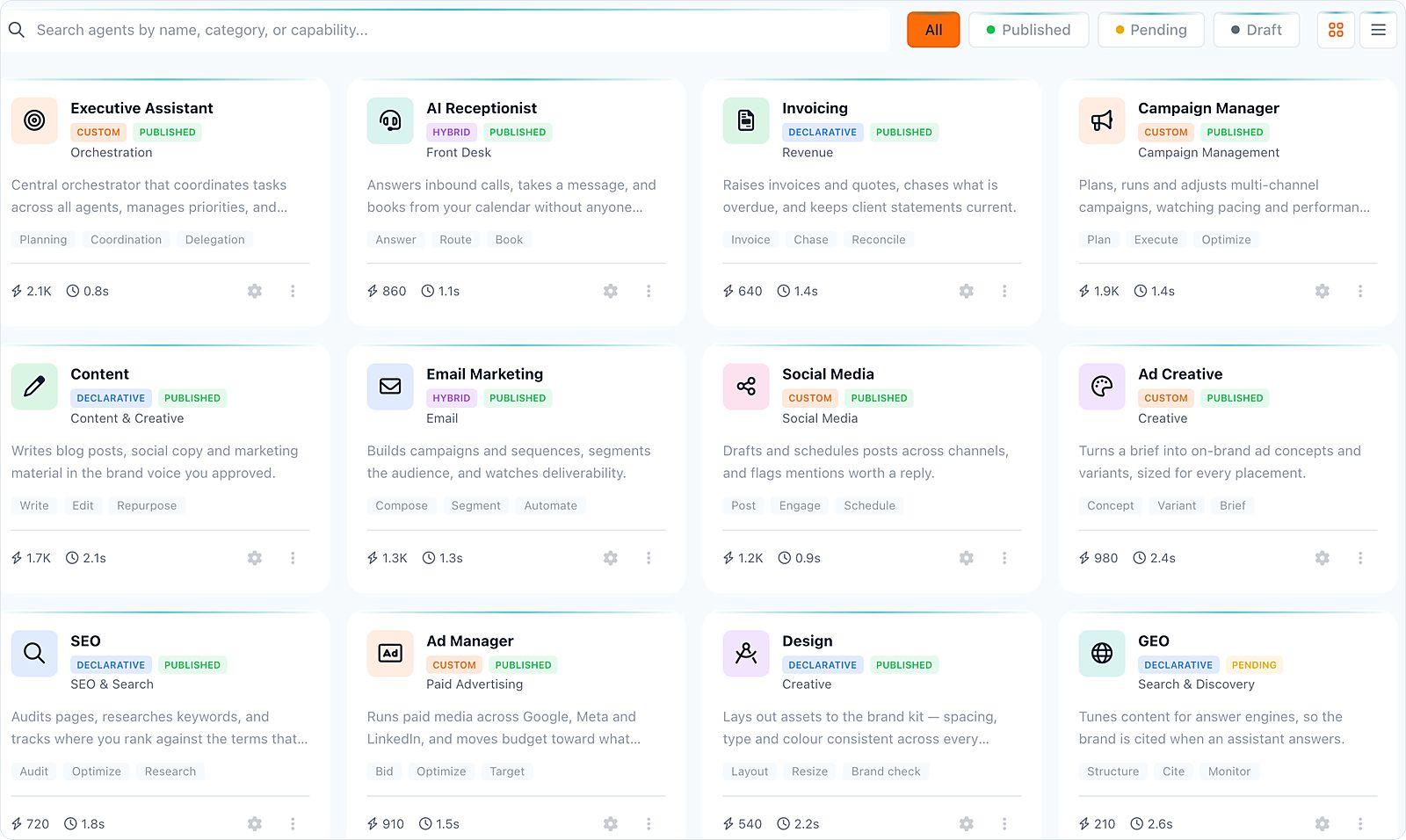
These are the agents you direct by name, grouped by the section each works in. The identifier under a card is its real name in the system — the same one you will see in the audit log. Behind them sit further system agents that route, coordinate and execute the work; you do not address those directly.
Builds grounded ad campaigns — search, display, social and video
For exampleA search campaign built from your offer — ad groups and copy — held in approvals before any spend.
ads_agent
Creates and manages marketing campaigns across channels
For exampleA cross-channel campaign with its budget split and an A/B test set up, queued for your sign-off.
campaign_agent
Creates blog posts, articles, whitepapers, and long-form content
For exampleA long-form blog post or case study drafted in your brand voice, ready to review.
content_agent
Creates ad copy, headlines, and creative concepts
For exampleA set of headline and ad-copy variants, adapted to each ad format.
creative_agent
Creates designs, banners, and graphics via AI
For exampleA social graphic or banner, resized for each placement it needs to run in.
design_agent
Creates emails, sequences, and manages email campaigns
For exampleA 3-step welcome sequence in your brand voice, with subject-line variants, queued for approval.
email_agent
Performs keyword research, SEO audits, and content optimization with real data
For exampleA technical audit of a page with its PageSpeed results, keyword targets and on-page fixes.
seo_agent
Creates social posts, schedules content, and manages social presence
For exampleA week of posts adapted to each platform, with hashtags, placed on the content calendar.
social_agent
Creates video scripts and initiates video production
For exampleA video script, then the production job started from it once you approve.
video_agent
Creates audience segments, targeting criteria, and personas
For exampleA segment built from your own contacts, with targeting criteria and a persona to write against.
audience_agent
Manages outreach campaigns, prospect enrollment, and sequence automation
For exampleProspects enrolled into an outreach sequence, with the sequence status tracked as it runs.
sdr_agent
Manages AI-powered calling campaigns, transcripts, and voicemail drops
For exampleA calling campaign scheduled, with call transcripts to review afterwards.
caller_agent
Finds and enriches leads using internal data sources
For exampleA lead list found and enriched from internal data, with company details attached.
leads_agent
Your personal AI sales assistant for leads, deals, and pipeline management
For exampleYour daily focus: the leads to prioritise, and a follow-up email drafted for each.
sales_associate
Creates pitch decks and battle cards, and analyses deal data
For exampleA battle card or pitch deck for a live deal.
sales_agent
Answers inbound calls and chats, qualifies the caller, books to the calendar and writes the result to the customer record. Inbound only — AI Caller is the outbound one
For exampleAn inbound caller qualified, booked onto your calendar, and the result written to their customer record.
Analyzes competitors and drafts battle cards
For exampleA battle card comparing a tracked competitor’s features and pricing with yours.
competitive_agent
Provides reports, metrics, insights, and forecasting
For exampleA performance report with a funnel breakdown and a forecast for the month.
analytics_agent
Scores content for AI answer engines and checks whether they cite you
For exampleA GEO score for a page, a check of whether AI answer engines cite it, and what to change.
geo_agent
Analyzes form completion, drop-off, and pipeline stage timing from real data
For exampleWhere visitors drop off a form, and how long deals sit in each pipeline stage.
journey_agent
Creates, sends, and manages invoices
For exampleAn invoice created and sent once you approve it, with its status tracked until it is paid.
invoice_agent
Manages scheduling, tasks, approvals, and coordinates with other agents
For exampleToday’s tasks and the approvals waiting on you, gathered in one place and scheduled.
executive_assistant
You describe an outcome. Darwin decides which agents are needed, in what order, and hands each one the context it requires. A campaign request routinely touches the audience, creative, email and ad agents without you naming any of them.
“A single campaign brief passes through four specialists before it reaches your approval queue, and you will not have named any of them.”
What one request actually triggers
Every agent reads the same brand voice, personas and product catalogue. You set the context once in Brand and none of them have to be told again.
The audience agent produces a real segment. The email agent writes against that segment, not against a guess about who is in it.
Work from several agents arrives as a single item in your approval queue. You review the outcome, not each agent's fragment.
Out of the box, agents propose. Nothing is published, sent or spent until a human approves it.
Raise the ceiling per agent and per action — let social posts publish automatically while ad spend still needs a signature.
One control stops every agent immediately, across the whole organisation, without uninstalling anything.
Autonomy is a setting, not a plan tier. Set it per campaign, per module or across the whole workspace, and change it whenever you like.
Every module keeps a full manual path. Build the campaign yourself and use the AI for nothing more than a second opinion.
Nothing runs unless you run it
The default. Agents research, write and schedule, then everything waits in your approvals queue until someone signs off.
Default on every plan
Hand over end-to-end execution within the limits you set — budget caps, send windows, channels, spend. Stop it in one click at any time.
You set the limits first
They take the part that kept slipping — the drafting, the chasing, the watching — and hand it back finished. The judgement stays yours, and teams who review the output get noticeably better results than teams who don’t.
Generated work is a strong first draft, not a finished asset. The approval queue is not a formality — it is where the quality comes from.
Context that lives in someone's head, or in a Slack thread from March, is invisible to every agent on this page.
They know your brand voice and your product catalogue. They do not know your market's unwritten rules the way an experienced hire does.
22 primary specialist agents covering 105 distinct capabilities, across marketing, audience, sales, brand, analytics, revenue and workspace. Those are the agents you direct by name, and all of them are listed on this page. They are supported by further system agents that route, coordinate and execute work behind the scenes.
No. You describe what you want to Darwin in plain English and it routes the work to whichever agents are needed. Naming an agent is possible but almost never necessary.
Yes, including the free plan, with three exceptions: SDR Outreach and AI Caller, which come with their paid add-ons, and Invoicing, which comes with agency accounts. There is no per-agent pricing. Otherwise plans differ on how much agent work you can run, not on which agents you can reach.
Not by default. Agents draft and propose; a human approves before anything is published, sent or spent. You can raise autonomy per agent and per action, and a kill switch stops everything at once.
It scores your content for generative engine optimisation — how likely an AI answer engine is to cite you — and then checks whether engines actually do. It is built into the same platform as the content it scores.
Brand voice, personas and the product catalogue live in the Brand section and every agent reads from them. Context is set once rather than pasted into each request.
Every agent is on every plan, including the free one, except SDR Outreach and AI Caller, which come with their paid add-ons, and Invoicing, which comes with agency accounts. No per-agent pricing.